_edited.png)
Best Sulphate Free Hair Care Products for Hair Extensions
Hair extensions can look glossy for months, or they can turn dry, tangled, and dull far too quickly. The difference often comes down to the products used on wash day and between washes. Extensions do not receive natural scalp oils in the same way growing hair does, so they need gentle cleansing, steady moisture, and styling products that will not cause build-up.
The safest starting point is simple: choose sulphate free hair care and avoid anything harsh, stripping, or heavy. This matters for clip-ins, tape-ins, wefts, nano rings, micro rings, and bonded extensions.

Why sulphate free products are best for hair extensions
Sulphates are cleansing agents found in many shampoos. They create a rich foam and remove oil well, but they can be too strong for extensions. On natural hair, the scalp can replace some of the oils lost during washing. Extensions cannot do that.
A sulphate free shampoo is usually gentler. It cleans without leaving the hair feeling squeaky, rough, or overly dry. This helps protect:
The softness of the extension hair
The colour and tone, especially on blondes, brunettes, balayage, and fashion shades
The bonds, tapes, or attachment points
The smooth finish, which reduces matting and tangling
Sulphate free does not always mean extension-safe, though. Some formulas contain heavy oils, waxes, or too much protein. The best products sit in the middle: gentle, moisturising, lightweight, and easy to rinse.
The best shampoo for hair extensions
The best shampoo for extensions should cleanse the scalp and roots without drying the mid-lengths and ends. Look for a shampoo labelled sulphate free, colour-safe, and moisturising.
A good extension shampoo should feel light, not creamy or waxy. It should rinse clean and leave the hair soft but not coated.
Choose shampoos with ingredients such as:
Aloe vera
Glycerin
Panthenol
Mild coconut-derived cleansers
Hydrolysed proteins in small amounts
Gentle botanical extracts
Avoid shampoos that promise a deep clarifying cleanse for regular use. Clarifying shampoo can be useful before fitting extensions or when there is product build-up, but it is too drying for frequent washing.
For tape-in extensions, take extra care with the roots. Avoid scrubbing directly over the tapes and do not apply oily shampoo near the adhesive. For bonds and rings, keep the scalp clean but use your fingertips gently rather than rough circular movements.
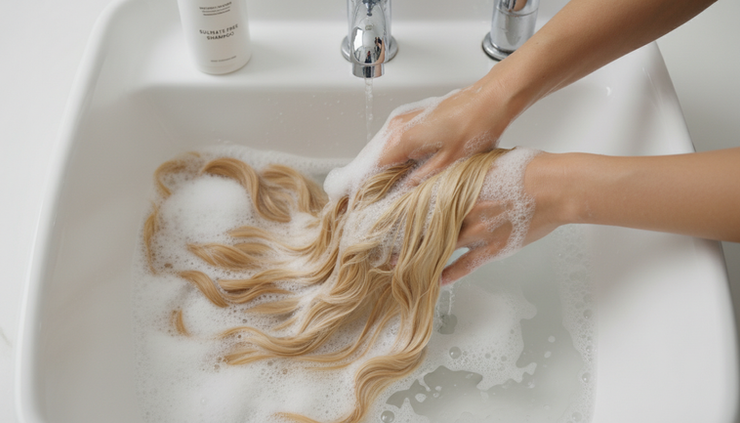
Best routine: shampoo twice if needed. The first wash lifts oil and product. The second wash cleans properly. Let the foam run through the lengths rather than piling the hair on top of the head.
The best conditioner for hair extensions
Conditioner is where extensions get much of their slip and softness. A good conditioner should hydrate the hair, smooth the cuticle, and make brushing easier after washing.
Look for a conditioner that says moisturising, smoothing, or colour-safe. It should be silicone-light or water-soluble silicone based, rather than heavy and greasy. Some silicones can be helpful for shine and detangling, but thick build-up can make extensions feel dull over time.
Apply conditioner from the mid-lengths to the ends only. Keep it away from tapes, bonds, rings, or weft seams. Conditioner near the attachment points can cause slipping, softening, or build-up.
Useful conditioner ingredients include:
Shea butter in small amounts
Argan oil in a lightweight formula
Panthenol
Amino acids
Keratin in balanced formulas
Jojoba oil
Vegetable proteins
Leave conditioner on for a few minutes, then rinse well. Poor rinsing is one of the main causes of limp, sticky, or tangled extensions.
Treatments that keep extensions soft
Treatments are useful, but only when chosen carefully. Extensions need moisture more often than strength. Too much protein can make the hair feel stiff or brittle, especially if the extensions have already been processed or coloured.
Use a moisturising mask once a week
A weekly mask can restore softness and improve manageability. Choose a sulphate free, extension-friendly mask with hydrating ingredients and a smooth, creamy texture.
Apply it below the attachment points. Comb through gently with a wide-tooth comb, leave it on as directed, then rinse thoroughly. Do not sleep in a wet mask unless the product clearly says it is suitable for overnight use.
Use protein treatments sparingly
Protein can help if the hair feels weak, stretchy, or overly soft. But for regular maintenance, moisture is usually more important. If the extensions feel rough or straw-like after a protein product, switch back to hydration.
Use leave-in conditioner for daily softness
A lightweight leave-in conditioner is one of the most useful products for extensions. It helps reduce friction, improves brushing, and keeps the ends from drying out.
Spray it onto the mid-lengths and ends before brushing. Avoid the roots and attachment points.

Styling products that work well with extensions
Styling products should protect the hair without making it sticky or heavy. Extensions tend to hold product build-up more than natural hair, so less is usually better.
The most useful styling products are:
Product | What it does | How to use it |
Heat protectant spray | Helps protect from styling tool heat | Mist through mid-lengths and ends before blow-drying or styling |
Lightweight serum | Adds shine and smooths frizz | Use one or two drops on dry ends |
Detangling spray | Adds slip before brushing | Spray lightly before combing |
Flexible hairspray | Holds curls or waves | Use a fine mist, then brush out gently |
Dry shampoo | Refreshes roots between washes | Use only on natural roots, away from tapes and bonds |
Avoid heavy oils near the roots. Coconut oil, castor oil, and thick butter-based styling creams can be too much for many extensions. They may soften tape adhesive, attract dust, or leave the hair feeling coated.
Heat protectant is non-negotiable if using straighteners, wands, tongs, or a hot brush. Keep tools on a moderate heat setting and do not pass over the same section again and again. Extension hair can dry out faster than natural hair when exposed to heat often.
Ingredients to avoid in extension hair care
Sulphates are the big one, but they are not the only ingredients to check. Labels can be confusing, so focus on the main red flags.
Avoid regular use of products with:
Sodium lauryl sulphate
Sodium laureth sulphate
Ammonium lauryl sulphate
Heavy mineral oil
Drying alcohols high on the ingredient list
Thick waxes
Strong clarifying agents
Sticky gels or glue-like styling products
Not every alcohol is bad. Fatty alcohols such as cetyl alcohol and stearyl alcohol are common in conditioners and can help soften the hair. The concern is with drying alcohols in products that leave the hair rough or dehydrated.
A simple product routine for extension care
A good routine does not need ten products. It needs the right ones used consistently.
For most extensions, this routine works well:
Brush gently before washing.
Wash with a sulphate free shampoo, keeping the hair flowing downwards.
Apply conditioner from mid-lengths to ends.
Use a moisturising mask once a week.
Spray leave-in conditioner before brushing damp hair.
Apply heat protectant before blow-drying or heat styling.
Finish with a small amount of lightweight serum on the ends.
Sleep with hair fully dry and loosely tied in a braid or low ponytail. Wet extensions are more fragile and more likely to tangle overnight.

The takeaway
The best products for hair extensions are gentle, moisturising, lightweight, and always sulphate free. Start with a mild shampoo and a nourishing conditioner, then add a weekly mask, leave-in spray, heat protectant, and light serum.
Keep rich oils and heavy styling creams away from the roots and attachment points. Rinse well, brush gently, and use heat carefully. With the right product routine, extensions stay smoother, softer, and easier to style for longer.


Comments